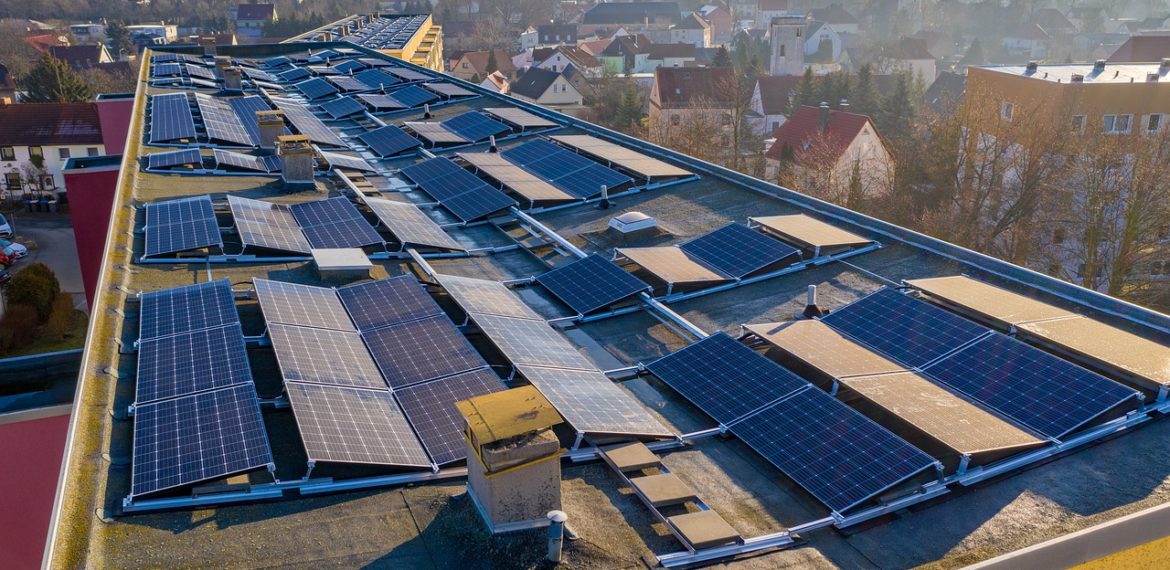
State commitments concerning the development of renewable energies (REN) translate concretely on the ground. local authorities are thus privileged actors in the development of this sector. To develop a production project for ENR, however, some key factors should be taken into account. Here is why the community has every interest in getting involved in this type of project, the constraints to be analyzed upstream and the possible sources of financing.
Why involve the community in the development of renewable energies?
According to a Survey conducted by ADEME (Agency for the environment and energy management), 94% of French people are in favor of the development of renewable energies. They are also 86% to want local production from ENR even if it costs a little more. A widespread idea, however, would like the population to be reluctant about the installation of renewable energy systems near their homes. However, according to ADEME, 89% of French people would accept one or more solar installations near their home.
The way therefore seems quite free for local authorities wishing to set up such projects. Especially since the energy transition process is today a major issue at the national and global level. For communities, getting involved in the development of renewable energies has many advantages. These include a concrete way to display their commitment to the energy transition. As the Bank of Territories explains, in its Guide for use by local authorities, this type of project also makes it possible to ensure economic benefits for the community. The production of ENR indeed boosts the creation of non-relocatable local jobs (installation and maintenance of equipment) and also makes it possible to control or even reduce the energy bill of the inhabitants.
Identify opportunities and constraints
To embark on a renewable energy production project on its territory, the community must first identify opportunities and constraints. It is thus possible to begin by taking an interest in public utility easements (SUP) that may affect land use. These easements are indicated in the local urban plan (PLU) and can also be published on the urban planning geoportal. They are divided into 4 categories which are:
- public health and safety
- Heritage conservation (forests, historical monuments, natural monuments, etc.)
- National Defense (military works, fortification, etc.)
- the use of certain equipment and resources (quarries, pipelines, railways, etc.)
Before starting a renewable energy production project, it is therefore essential to check the constraints specific to each territory. The SUPs will define the feasibility of the project. The easements with the most impact on the installation of renewable energy equipment are the historical monuments, the perimeter to be respected near the classified sites, the natural hazard prevention plan or even protected agricultural areas.
The development of renewable energies in the municipality must also take into account the preservation of landscapes. The installation of photovoltaic panels on the ground will indeed have a direct impact on the landscape. It is therefore necessary to study the location of the site upstream in order to select a place that satisfies both the needs of the installation and for the inhabitants. Abandoned places such as old quarries or industrial wastelands are in this sense candidates of choice for the installation of a renewable production unit.
Study the sources of funding
After having dimensioned the photovoltaic project according to the needs of the municipality, it is necessary to take stock of the possible financings. Several possibilities can be envisaged as partially or in full funding from the local authority’s own funds. If a need for external financing is necessary, banking institutions can offer loans. These can be reimbursed in particular thanks to the economic benefits generated by the photovoltaic installation (in particular in the event of resale of electricity). Crowdfunding is today a common method that can be applied to such a project. Involving the inhabitants of the municipality and the companies is a way to involve the whole municipality in the development of renewable energies.
Finally, some financial aid can facilitate the establishment of a renewable energy production project in a municipality. Several devices are proposed in this sense, such as the Financing of the Bank of Territories. This organization, for example, proposes financing that can be done either by a minority investment in equity or by an investment in quasi-equity. SEM (mixed-economy) or SEMOP (single-operation single-operations company) type arrangements are also possible. The Banque des Territoires thus supports projects that can focus on the development of self-consumption within the community, the development of infrastructure for ENRs or even the optimization of energy storage.
IRISOLARIS is also your privileged interlocutor for the implementation of a renewable energy production project. A team of specialists helps you define your needs, identify constraints and find funding that can help you make your project a reality. Do not hesitate to contact us.

Manage consent
Strictly necessary cookies Always active
These cookies are essential for the functioning of the site.
Preferences
The technical storage or access is necessary for the legitimate purpose of storing preferences that are not requested by the subscriber or user.
Google Analytics
The technical storage or access that is used exclusively for statistical purposes.
The technical storage or access is necessary for the legitimate purpose of storing preferences that are not requested by the subscriber or user.
Marketing
The technical storage or access is required to create user profiles to send advertising, or to track the user on a website or across several websites for similar marketing purposes.