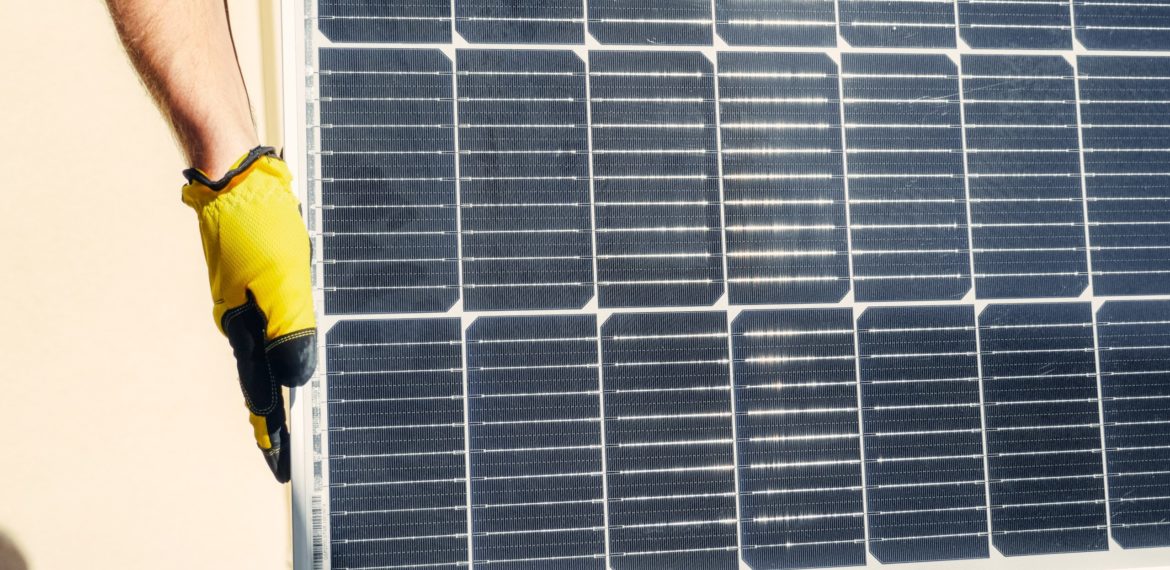
According to official figures from the Ministry of Ecological Transition, the solar sector has undergone strong development since 2009. In 2020, France recorded a Production of 13.6 TWh of photovoltaic energy an increase of more than 11% compared to the previous year. This interest in solar has been favored by state aid for individuals and professionals. It is thus increasingly easy to install photovoltaic panels but projects must still respect strict conditions. Focus on the necessary planning permissions for your solar roof project.
What permissions do you get for installing solar panels?
According to theArticle R.421-17 of the town planning code, works not subject to the building permit but which modify the exterior appearance of a building must be the subject of a prior declaration of work. The installation of solar panels on a roof therefore falls within this framework. Before launching your work, you will therefore have to make a declaration to the town hall. If it is a new construction on which you plan to integrate photovoltaic panels, you will have to apply for a building permit and include your solar roof project in the file..
The town hall is your privileged interlocutor since it is she who issues planning permissions. The training periods are on average 1 month for a declaration of work, 2 months for a building permit and up to 4 months for an establishment open to the public (ERP). For buildings located in a classified area, the delays are often twice as long and the steps differ a little.
Good to know : The photovoltaic installations on the ground are also subject to authorization. The type of planning permission, on the other hand, depends on their height and power. For installations less than 1.80 m high and with a power less than 3 kW, no authorization is requested. On the other hand, for installations less than 1.80 m between 3 and 250 kW and installations over 1.80 m high and with a power less than 250 kW, a prior declaration is necessary. If the power exceeds 250 kW, it is then necessary to apply for a building permit *.
The special case of protected areas
If your building is located in a classified or protected area, authorizations may be more difficult to obtain. However, refusals are increasingly rare. Your project must simply respect the directives of the architects of the buildings of France (ABF). Before launching your work, you must indeed send your file to the ABF which will check that your installation does not hinder the aesthetics of the area near a historic monument or a remarkable site. If your building is visible from the historic monument, the ABF agreement is essential. If it is not visible, although it is located in a classified area, the ABF agreement is not necessary.
The special case of the ENR production obligation
In order to promote the use of renewable energies, some new buildings are now obliged to integrate renewable energy systems. It’s theArticle L111-18-1 of the town planning code which specifies this measure. Until July 1, 2023, the building permit for all buildings of more than 1,000 m² must include either a ENR production process or a revegetation system. The Choice System should also cover at least 30% of the roof or shade surface. After July 1, 2023, this measure is extended to the construction, major renovation and expansion of offices of more than 1,000 m², commercial, artisanal and industrial buildings of more than 500 m² and covered car parks including The footprint exceeds 500 m2. The chosen system should also cover at least 50% of the roof surface. To obtain their planning permission, the buildings concerned will therefore have to respect this new initiative.
When to start the work?
Once you have obtained the necessary planning authorizations, you will be able to launch the work. For this, remember to display the authorization at the site of the site as soon as the document is received until the end of the work. Do not forget to send your site opening declaration to the town hall if it requires a building permit. You will then have to start your photovoltaic roof installation work within two years of receipt of the planning authorization. Attention, once started, the construction site cannot be interrupted for more than a year. Once the work is complete, all you have to do is send a declaration of completion and compliance of the works to the town hall of your municipality (DAACT).
Having solar panels on the roof of your agricultural building, warehouse or business premises requires you to follow key steps. To help you set up your project and obtain all the essential authorizations, do not hesitate to call on a Gisco expert. He will be at your side throughout the duration of your project to guide you and offer you solutions adapted to your needs.
Sources:

Manage consent
Strictly necessary cookies Always active
These cookies are essential for the functioning of the site.
Preferences
The technical storage or access is necessary for the legitimate purpose of storing preferences that are not requested by the subscriber or user.
Google Analytics
The technical storage or access that is used exclusively for statistical purposes.
The technical storage or access is necessary for the legitimate purpose of storing preferences that are not requested by the subscriber or user.
Marketing
The technical storage or access is required to create user profiles to send advertising, or to track the user on a website or across several websites for similar marketing purposes.