Local authorities: how to set up a photovoltaic project on your territory?
Local authorities are major players in the energy transition. Their fundamental role was reaffirmed in 2015 by the Energy Transition Law for Green Growth (TEPCV). This encourages, or even imposes, the development of Territorial Climate Air Energy Plans (PCAET). The goal? Define and implement a local energy strategy. One of the challenges? Make the territory energetically autonomous. Stocks? Control energy consumption and develop local renewable energies.
natural, infinite, reliable, technologically mature and local short circuit, Solar energy is acclaimed by communities to take up this challenge. It is also the ideal solution to respond to the new Environmental Regulation (RE 2020). Since 1er January 2022, the construction of any new public building must provide for autonomous production of energy from renewable resources.
But how to set up a photovoltaic project? Here are the main steps to follow for Define an efficient and coherent project for your territory.
1st stage of a photovoltaic project: carry out the opportunity and feasibility study
Evaluate the energy needs of the territory
Any solar project begins with the study of potentials to verify technical and financial feasibility. This allows to Sizing the future photovoltaic installation, in line with local needs. How to proceed?
· By evaluating consumption potentials : assessment of local energy consumption (large project) or building energy consumption (target project), observation of periods of peak consumption and low consumption, etc.
· estimating the solar potential : verification of the duration and the sunshine force, taking into account seasonal changes, search for optimization techniques (orientation, inclination) etc.
Identify locations
Three main solutions are available to local authorities for the installation of photovoltaic panels:
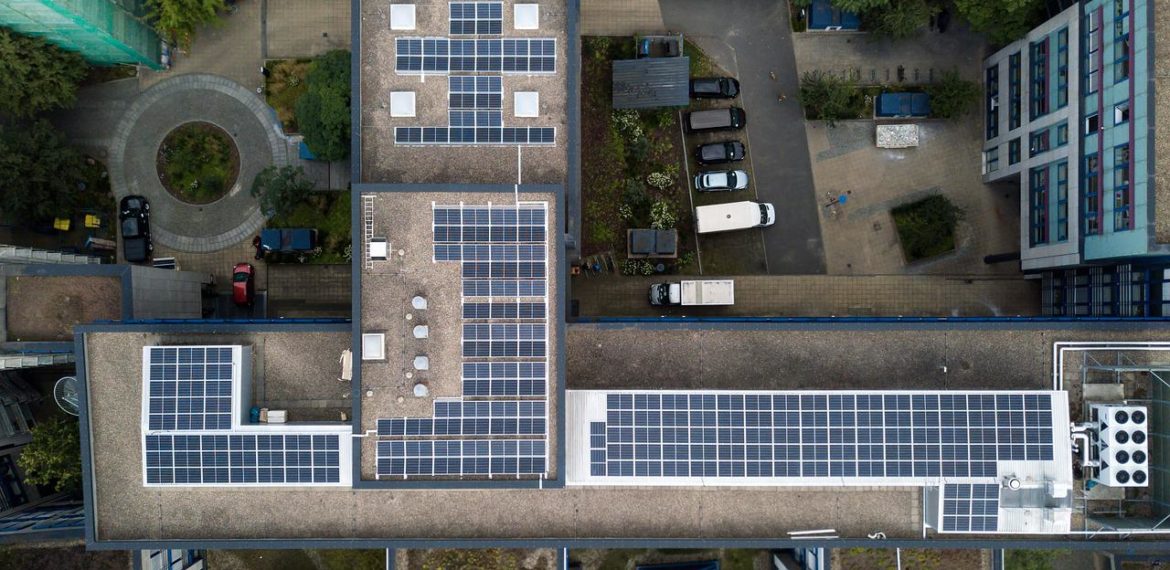
- · The roofs and facades of public buildings : They are suitable for small solar installations. The electricity produced can be self-consumed or reinjected into the public electricity distribution network.
- · Photovoltaic ombre in the car parks : more expensive, they have the advantage of exploiting surfaces that are already artificial.
- Solar parks on the ground or photovoltaic fields: Large area, they are adapted to ambitious photovoltaic installations, often intended for local consumption. They value land that has become unusable (siltlands, sites polluted by waste landfilling, abandoned industrial land, etc.)
remove legal, technical and environmental constraints
Like any construction, the installation of photovoltaic panels must follow the rules and standards in force on the territory. It is therefore necessary to take into account:
- · Local town planning rules (constructible areas, land use rules, protected agricultural areas, etc.)
- risks identified in prevention plans natural and technological risks.
- rules related to the Proximity to a local heritage (Historical monuments, classified sites)
- environmental protection, landscapes, natural carbon sinks…
· For projects over 250 kilowatt-peak (kWC), a Environmental Assessment is mandatory. It includes an impact study and a public inquiry.
2nd step: choose the legal and financial arrangement adapted to the photovoltaic project
There is a multitude of legal and financial arrangements. In their reflection and the choice of operators, elected officials must be guided by two questions:
- what Place for public and local governance ?
- what Financial contribution from the community ?
Depending on the type of assembly, the investment of the municipality or group of municipalities will be more or less significant. It can be financed by equity, bank loans, aid and subsidies or with the contribution of crowdfunding.
Portage by the community
The community can choose to Carrying the photovoltaic project alone. This choice is rather suitable for small installations with a limited investment. However, this requires Skills that can be mobilized internally. The creation of a control room is mandatory to fully or partially sell the electricity produced. The advantage? The community keeps the Mastery of the project and its financial benefits.
The Third-party investment is also a solution. It consists of entrusting the installation, operation and maintenance of solar panels to a private company. Production is either self-consumed (the community then pays rent to the company), or reinjected into the network (the company then pays rent to the community).
collective portage
the community may prefer sAssociate with dOther operators to carry out the project. It Increases investment capacity and pooling skills.
The control and governance capacity of the municipality or intermunicipal authority will depend on the amount of its financial participation.
- To preserve public governance, it can opt for the constitution of a Local Public Company (SPL), composed of exclusively public shareholders.
- the mixed economy company (SEM) is an intermediate solution To preserve public governance: a private law company, it is made up of public majority shareholders and private minority shareholders.
- The project can be delegated as part of a public contract to a private company: the community can either build the facility and delegate the operation (affermage), or delegate the entire project (concession).
- Other legal arrangements are still possible: the Public-private partnerships (PPP) for large-scale projects or participation in cooperative societies of collective interest (scic) carried by citizen collectives.
Become a shareholder in a private photovoltaic project
Finally, the community can take a financial participation in a private company carrying a photovoltaic project on its territory. Its weight in governance will depend on the negotiations but it generally remains rather limited.
Communicate to promote social acceptance
If solar energy is theoretically acclaimed, photovoltaic installations, sometimes imposing, can cause Rejection reactions. The reasons? Mainly environmental, landscape or heritage fears, but also fear of nuisance.
Information, explanation, consultation, participation are the keys to an accepted project. it is essential to involve From the first thoughts local actors concerned : environmental associations, collectives of citizens, residents, population in the broad sense, actors concerned by any conflicts of use (hunter associations, farmers, military base, etc.).
A well-accompanied photovoltaic project is an excellent opportunity to Strengthen social cohesion of the territory and to federate local actors About a common and sustainable project.
These steps may take from a few months to several years depending on the extent of the photovoltaic installation. And thus mark with a concrete act your commitment to the energy transition and your territory!

Manage consent
Strictly necessary cookies Always active
These cookies are essential for the functioning of the site.
Preferences
The technical storage or access is necessary for the legitimate purpose of storing preferences that are not requested by the subscriber or user.
Google Analytics
The technical storage or access that is used exclusively for statistical purposes.
The technical storage or access is necessary for the legitimate purpose of storing preferences that are not requested by the subscriber or user.
Marketing
The technical storage or access is required to create user profiles to send advertising, or to track the user on a website or across several websites for similar marketing purposes.